


- Author By :
- Date :
GST on House Construction: The Truth Behind “No GST” Quotations
GST on House Construction: The Truth Behind “No GST” Quotations
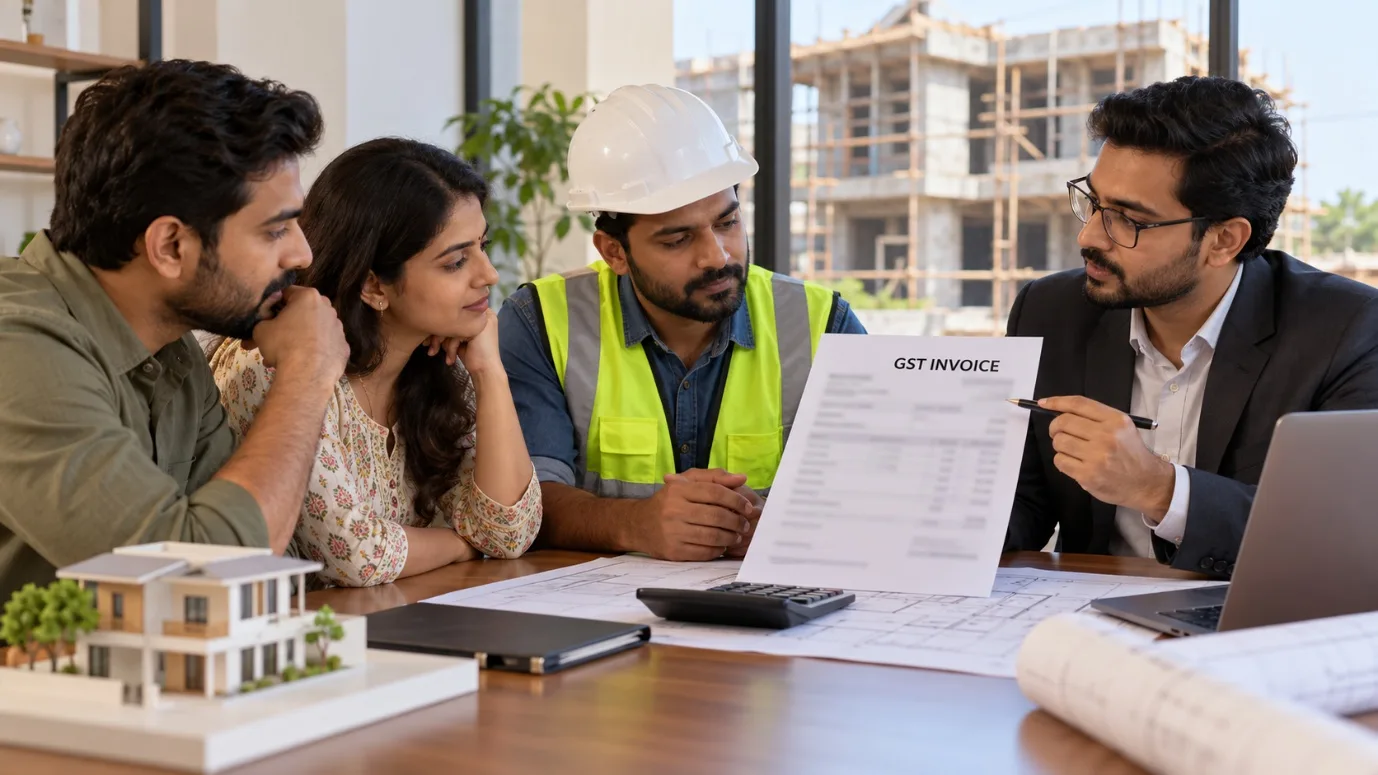
GST on House Construction: The Truth Behind “No GST” Quotations Building a house is a major financial and emotional commitment. A family may spend years saving money, purchasing land, arranging a loan and planning every part of the building. When construction quotations are collected, even a small difference in price can influence the final decision.
This is where GST on house construction creates confusion.
ne construction company may submit a proper quotation showing the construction value and 18% GST. Another contractor may simply say, “No GST,” or offer to complete the work without a tax invoice. The second quotation immediately appears cheaper.
The natural question from the client is: “Why should I pay 18% more when another contractor is not charging it?” But GST is not an additional profit decided by the construction company. It is a tax imposed by the Government. Whether GST applies depends on the actual nature of the transaction—not on what the client or contractor prefers to call it.
Understanding this difference is important before comparing construction quotations.
GST Is Collected for the Government
GST charged by a registered construction company is not fully retained by the company as income. For a normal taxable construction contract within the same State, GST is generally divided into 9% Central GST and 9% State GST.
The contractor collects this amount through the invoice, adjusts the eligible Input Tax Credit available on business purchases and deposits the balance with the Government through the GST system.
For example, if the taxable construction value is ₹10 lakh, the GST at 18% will be ₹1.80 lakh. The total invoice value becomes ₹11.80 lakh.
This does not mean that the contractor has earned ₹11.80 lakh. The construction value is ₹10 lakh, while ₹1.80 lakh is the statutory tax collected on the supply.
The contractor may receive Input Tax Credit for eligible GST already paid on cement, steel, blocks, concrete, electrical materials, plumbing materials, equipment hire, subcontract services and other project inputs. This eligible credit is adjusted against the GST collected from the client. The remaining liability is paid to the Government.
Therefore, GST is part of the tax chain. The 18% GST on construction is not a profit margin for the contractor.
Why a Material-and-Labour Contract Attracts 18% GST
When a contractor supplies construction materials as well as labour for building an immovable property, the contract is generally treated as a works contract.
Section 2(119) of the Central Goods and Services Tax Act defines a works contract as a contract relating to the construction, completion, fitting out, repair, renovation, alteration or similar work of an immovable property where the transfer of property in goods is involved.
Schedule II of the Act treats a works contract as a supply of service.[1]
This means that, for GST on works contract, a single construction contract cannot normally be divided merely on paper and taxed separately as cement, steel, blocks and labour. When the contractor is responsible for supplying the materials and executing the building, the complete contract is generally treated as one works-contract service.
Under the current construction-service rate structure, GST on house construction under an ordinary material-and-labour works contract is generally charged at 18%.[2]
This normally covers: Turnkey construction of an independent house or villa. Construction of apartments, PGs and hostels. Commercial buildings, shops, offices and warehouses. Industrial and institutional buildings.
Material-and-labour renovation or extension work. Fixed civil and interior works forming part of a building. Works-contract services provided by subcontractors.
The use of the building does not by itself remove GST. A house constructed for the owner’s personal use may still involve a taxable works-contract service supplied by the contractor.
The Main Confusion: Apartment GST Is Not Contractor GST
Many people have heard that GST on residential property is only 1% or 5%. They then expect the same rate from a contractor constructing a house on their land.
These are two different transactions.
The 1% and 5% rates mainly apply when a promoter or builder sells an under-construction apartment as part of a real-estate project.
The effective rates are generally:
| Type of promoter sale |
Effective GST rate |
Input Tax Credit |
| Affordable residential apartment |
1% |
Not available |
| Other residential apartment |
5% |
Not available |
| Commercial apartment situated in a qualifying Residential Real Estate Project |
5% |
Not available |
| Commercial apartment in a Real Estate Project other than an RREP |
12% |
Available subject to the law |
For Bengaluru, an affordable residential apartment generally requires a carpet area not exceeding 60 square metres and a gross amount charged by the promoter not exceeding ₹45 lakh.[3]
These rates apply to a promoter’s sale of an apartment before the applicable completion or occupation stage. They are not alternative tax rates available to a contractor constructing a private house on land already owned by the client.
A contractor cannot legally say: “The normal rate is 18%, but I will charge 5% because the building is residential.”
Residential use alone does not convert a private works contract into a promoter’s apartment sale.
The Pure-Labour Exemption Is Limited
Another common statement is that GST on house construction is fully exempt for residential projects. This is only partly correct.
Entry 11 of Notification No. 12/2017–Central Tax (Rate) provides the pure labour contract GST exemption for original works relating to a single residential unit otherwise than as part of a residential complex.[4]
For this exemption to be considered, the contractor must genuinely provide labour only. The owner must separately purchase and arrange the cement, steel, blocks, concrete and other materials.
The exemption is limited. It does not automatically cover:
- A contractor supplying both materials and labour.
- A residential complex containing more than one residential unit.
- A PG, hostel or apartment block. Commercial construction.
- A contract described as labour-only when the contractor is actually purchasing and supplying materials.
- Every private repair, remodelling or renovation contract.
A gated entrance is not the legal test. The important question is whether the building forms part of a residential complex having more than one self-contained residential unit.
Pure labour is therefore one specific exemption. It is not a general exemption for all residential construction.
A Contractor Below the Registration Limit Is Different
A small contractor may not be required to register under GST if the applicable registration conditions and turnover limits are not crossed.
Such a contractor cannot collect GST merely because GST exists. However, this situation must not be confused with an exemption for the construction project itself.
There is a difference between:
- The construction service being legally exempt.
- The contractor not yet being liable for GST registration.
- The contractor being registered under a special scheme.
- A registered normal taxpayer failing to charge GST on a taxable contract.
The reason GST is not being charged must therefore be clearly identified.
A contractor who is below the registration threshold may also have a different business scale, procurement structure, documentation system and execution capacity. GST registration alone does not decide construction quality, but quotations should not be compared only by looking at the final number.
The 6% Scheme for Eligible Small Service Providers
An eligible small service provider with aggregate turnover up to ₹50 lakh in the preceding financial year may, subject to the prescribed conditions, opt for the special 6% scheme under Notification No. 2/2019–Central Tax (Rate).[5]
Under this scheme:
- The supplier cannot claim Input Tax Credit.
- The supplier cannot collect GST separately from the client.
- A bill of supply must be issued instead of a tax invoice.
- The tax is paid by the supplier from the amount collected.
- The supplier must satisfy the turnover, registration and other eligibility conditions.
Therefore, a contractor cannot claim to be under the 6% scheme and simultaneously add “6% GST extra” to the client’s bill.
The 6% scheme is also not an automatic alternative available for every project. Eligibility must be verified.
When There Is No GST on a Property Sale
Sale of land is outside GST.
Sale of a completed building is also generally outside GST when the transaction takes place after the legally applicable completion certificate or first occupation point. Schedule III treats such sale differently from the supply of under-construction property.[1]
However, this does not mean that the construction services used to build that completed property were GST-free.
The promoter, contractor, consultant and material suppliers may have already paid or collected GST during the construction process. The later sale of the completed property is a separate transaction.
This distinction is frequently missed when people say, “There is no GST on a completed house.”
Why Some Government Contracts Carry 12%
Another source of confusion is the 12% GST rate sometimes seen in government tenders.
Under the rules for GST on works contract, most ordinary construction and works-contract services now fall under the general 18% rate. Several earlier concessional entries were changed with effect from 18 July 2022.[6]
However, a few specialised 12% entries continue, including certain:
- Works contracts involving predominantly earthwork, where earthwork constitutes more than 75% of the contract value and the specified recipient conditions are satisfied.
- Corresponding subcontract works under the notified earthwork category.
- Offshore oil-and-gas works contracts covered by the specific notification entry.
A project does not become eligible for 12% merely because the client is a Government department or Government-related organisation. The precise notification entry, type of work and recipient must all be checked.
Similarly, a private residential contractor cannot use a specialised government rate for an ordinary house-construction contract.
“With ITC” Does Not Mean the Homeowner Gets the Credit
The words “with ITC” are also misunderstood.
When a normal contractor charges 18% GST, the contractor may generally claim eligible credit on the GST paid for materials, subcontractors and services used for making the taxable works-contract supply.
This does not mean that an individual homeowner can claim back the GST paid to the contractor.
For a person constructing a private residential house, input tax credit on house construction is normally unavailable. ITC on works-contract services and goods or services used for construction of immovable property on one’s own account is also generally blocked under Section 17(5), subject to the statutory exceptions and the specific facts of the transaction.[1]
The practical position is:
| Person claiming ITC |
General position |
| Normal contractor making a taxable works-contract supply |
Eligible ITC may generally be claimed |
| Main contractor receiving eligible subcontract services |
ITC may be available for further supply of works-contract service |
| Individual constructing a personal house |
ITC is normally unavailable |
| Promoter paying 1% or 5% on apartment sales |
ITC is not permitted under that rate structure |
| Business constructing and owning a building |
ITC is generally restricted or blocked under Section 17(5) |
| Eligible plant and machinery |
Requires a separate examination under the statutory definition |
The contractor’s ITC and the client’s ITC are two separate questions.
How “No GST” Quotations Mislead Clients
A quotation showing “No GST” may look attractive, but the statement by itself is incomplete.
There may be a valid reason:
- The supplier is not liable for registration.
- The work genuinely qualifies for a notified exemption.
- The contractor is eligible under a special tax scheme.
- The owner is directly purchasing all materials and the contract is genuinely for labour only.
There may also be an invalid reason:
- The contractor wants to receive payment without recording the complete transaction.
- A material-and-labour contract is being shown only as labour.
- The quotation excludes GST initially, but the tax is demanded after work begins.
- GST is said to be included, but no proper tax invoice is issued.
- The contract amount, bank payments and invoices do not match.
- Part of the payment is requested in cash without supporting records.
The words “No GST” are not enough. The contractor should be able to explain the exact legal reason and issue the correct document for that tax position.
What Happens When GST Is Hidden at the Quotation Stage
The immediate effect is an unfair comparison.
Consider two quotations for the same scope:
| Particulars |
Contractor A |
Contractor B |
| Construction value |
₹50,00,000 |
₹50,00,000 |
| GST clearly stated |
₹9,00,000 |
Not mentioned |
| Quoted total |
₹59,00,000 |
₹50,00,000 |
Contractor B appears ₹9 lakh cheaper. But the quotation does not explain whether:
- GST is legally not applicable.
- GST is included within ₹50 lakh.
- GST will be added later.
- The contractor is unregistered.
- The contractor is under a special scheme.
- The taxable transaction is being kept outside the records.
If GST is demanded after the agreement or after construction starts, the client may not have sufficient freedom to change the contractor. The apparent saving can become an unexpected project cost.
This is why GST on house construction must be clarified before comparing the base rates.
Consequences for the Client
When GST is not handled properly, the client may face more than a tax-rate difference.
The consequences may include:
- An unexpected GST demand after commencement of work.
- Disputes about whether the agreed price included or excluded tax.
- Difficulty proving cash payments or payments made without invoices.
- Mismatch between the agreement value, project value and payment records.
- Weak documentation during arbitration, consumer disputes or civil proceedings.
- Difficulty establishing the actual materials, services and value supplied.
- Reduced accountability for warranties, variations and incomplete work.
- Problems when project costs must be explained to a bank, investor, auditor or tax authority.
- Artificially low initial pricing followed by later claims and adjustments.
The client is not automatically responsible for every GST default committed by the contractor. The registered supplier is ordinarily responsible for correctly invoicing, reporting and paying tax on the taxable supply.
However, knowingly participating in false invoicing, artificial contract splitting or concealed transactions can create a much more serious problem. Even where the tax department proceeds mainly against the contractor, the client may still be left with incomplete records and a difficult contractual dispute.
Consequences for the Contractor
A registered contractor who fails to report a taxable supply may face:
- Demand for unpaid or short-paid tax.
- Applicable interest. Financial penalties.
- Proceedings for suppression or wilful misstatement where established.
- Penalty for failure to issue the prescribed invoice.
- Action where GST is collected but not deposited with the Government.
- Cancellation or suspension-related compliance consequences.
- Loss of commercial credibility and difficulty participating in formal projects.
If GST is collected from a client, it must be dealt with according to the law. A contractor cannot collect an amount as GST and retain it as business income.
How Clients Should Compare Construction Quotations
The correct comparison must begin with the base construction value.
Before selecting a contractor, the client should confirm:
- The value of the construction work before GST.
- Whether materials and labour are both included.
- Whether the contractor is registered under GST.
- The GSTIN stated in the quotation.
- The applicable GST rate and legal basis.
- Whether GST is included in the quoted amount or payable additionally.
- Whether a tax invoice or bill of supply will be issued.
- Whether payments will be made through a documented banking channel.
- The project scope, specifications, exclusions and additional items.
- he treatment of variations, escalation and additional work.
A quotation charging 18% GST on construction may appear higher only because the statutory tax has been disclosed correctly. A quotation not showing GST may be genuinely valid, incomplete or non-compliant. The reason must be established before comparing the totals.
The Construction GST Position in One View
| Transaction |
General GST position |
| Qualifying pure-labour contract for one single residential unit |
Nil |
| Affordable apartment sold by a promoter before completion |
1% without ITC |
| Other residential apartment sold by a promoter before completion |
5% without ITC |
| Commercial apartment in a qualifying RREP |
5% without ITC |
| Eligible small service provider under the special scheme |
6% without ITC; cannot collect separately |
| Commercial apartment in a REP other than an RREP |
12% with ITC |
| Certain notified government earthwork and specialised contracts |
12% with ITC |
| Normal material-and-labour house-construction contract |
construction contract18% with eligible ITC to the contractor |
| Commercial, PG, hostel and multi-unit works contract |
Generally 18% |
| Repair, renovation and fixed civil-interior works | Generally 18% |
| Architectural, engineering and project-consultancy services | Generally 18% |
| Sale of land | No GST |
| Qualifying sale of a completed building | No GST on the property sale |
The Real Question Is Not “Who Charges Less GST?”
GST on house construction should not be used as a marketing discount.
The correct question is not: “Which contractor is charging less GST?”
The correct questions are: “What is the actual nature of this transaction?
What rate does the law prescribe? Why is GST being charged—or why is it not being charged?”
A genuine exemption should be supported by the correct contract structure and documentation. A supplier outside the registration requirement should clearly state that position. A composition taxpayer should issue the required bill of supply and should not collect GST separately.
But when a taxable material-and-labour construction contract is merely advertised as “GST-free,” the apparent saving may later become an additional cost, a documentation failure or a legal dispute.
For a family building its home, clarity before signing the agreement is far safer than discovering the tax position after construction has already started.
Official References
[1] Government of India, Central Goods and Services Tax Act, 2017—including Section 2(119), Schedule II, Schedule III and Section 17(5):
India Code – Central Goods and Services Tax Act, 2017
[2] Government of India, Notification No. 11/2017–Central Tax (Rate), as amended—rates applicable to construction services under Heading 9954:
CBIC – Notification No. 11/2017
[3] GST Council, Frequently Asked Questions on GST in the Real Estate Sector—1%, 5% and 12% rates, affordable housing definition and RREP treatment:
GST Council – Real Estate Sector FAQ
[4] Government of India, Notification No. 12/2017–Central Tax (Rate), Entry 11—pure-labour exemption for a qualifying single residential unit:
CBIC – Notification No. 12/2017
[5] Government of India, Notification No. 2/2019–Central Tax (Rate)—6% scheme for eligible small service providers:
GST Council – Notification No. 2/2019
[6] CBIC Circular No. 177/09/2022–TRU—clarifications concerning rate changes effective from 18 July 2022:
CBIC – Circular No. 177/09/2022
This article is intended for general public awareness. GST applicability depends on the nature of the supply, registration status, contract structure, project type and current notifications. A qualified GST professional should review the tax treatment of a specific project before the contract and invoicing structure are finalised.
Frequently Asked Questions About GST on House Construction
1. Is GST optional in a construction contract?
No. When the construction service is taxable and the contractor is required to collect GST, the client and contractor cannot remove it by mutual agreement. The applicable GST depends on the actual work, contract structure and supplier’s registration status.
2. What is the normal GST rate for constructing a house on the owner’s land?
When a registered contractor supplies both materials and labour, the contract is generally treated as a works-contract service and taxed at 18%. This applies even when the building is an independent residential house constructed only for the owner’s personal use.[1][2]
3. Why do some builders charge only 1% or 5% GST?
The 1% and 5% rates mainly apply to under-construction apartments sold by promoters:
- 1% without ITC for qualifying affordable residential apartments.
- 5% without ITC for other residential apartments.
These rates do not normally apply when a contractor constructs a house on land already owned by the client.[3]
4. When is a pure-labour house-construction contract exempt?
A genuine pure-labour contract for original construction of one residential unit may qualify for the pure labour contract GST exemption when it is not part of a residential complex.
The owner must separately purchase and arrange all construction materials. A contractor supplying both materials and labour cannot use this exemption.[4]
5. Why does another contractor say that no GST is applicable?
There may be a valid reason:
- The contractor is not liable for GST registration.
- The work genuinely qualifies for exemption.
- The contractor is eligible under a special tax scheme.
- The contract is genuinely for labour only.
There may also be an incorrect reason, such as suppressing the transaction, showing a material contract as labour-only or planning to demand GST after construction begins. The client should ask for the legal reason in writing.
6. Is the 18% GST retained by the contractor as profit?
No. GST is a Government tax collected through the contractor’s invoice.
The contractor may adjust eligible Input Tax Credit on materials and services and must discharge the remaining GST liability through the GST system. The 18% tax is not an additional profit margin.
7. Who can claim Input Tax Credit?
A normal contractor charging 18% GST may generally claim eligible ITC on materials, subcontractors and services used for the taxable construction work.
A private homeowner normally cannot claim input tax credit on house construction, so the GST paid for a personal house cannot be claimed back. ITC on construction of immovable property is also generally restricted under Section 17(5), subject to the provisions and exceptions in the Act.[1]
8. Can a contractor split the contract or choose a lower GST rate?
A contractor cannot artificially divide a single material-and-labour contract only to reduce GST. The agreement, purchasing responsibility, invoices, payments and actual method of execution must support the contract structure.
Similarly, a contractor cannot choose 5%, 12% or 18% merely based on whether ITC will be claimed. The rate must come from the applicable legal entry.
9. What are the risks of accepting a “No GST” quotation?
The possible consequences include:
- GST being demanded after work starts.
- Disputes about whether GST was included in the contract price.
- Payments being made without proper invoices.
- Mismatch between the agreement, invoices and bank payments.
- Weak evidence during contractual or legal disputes.
- Reduced accountability for materials, variations and warranties.
A lower quotation is not a genuine saving unless the reason for not charging GST is legally valid.
10. What should a client verify before signing the agreement?
The client should verify:
- The contractor’s GSTIN and registration status.
- The construction value before GST.
- Whether materials and labour are both included.
- The applicable GST rate and its legal basis.
- Whether GST is included or payable additionally.
- Whether a tax invoice or bill of supply will be issued.
- The legal reason if GST is not being charged.
- Whether the agreement, quotation, invoice and payment account belong to the same entity.
The safest question is:
“What is the legal basis for the GST rate shown in this quotation, and what invoice or bill will be issued for every payment?”
These FAQs are for general public awareness. GST treatment depends on the actual supply, registration status, contract structure and notifications in force. A qualified GST professional should review the tax treatment of a specific project.
Planning to Build Your Home in Bangalore?
Looking for a reliable building construction company in Bangalore?
Get in touch with Srusti Constructions to discuss your home construction requirements, project scope, construction quotation, material and labour costs, GST applicability, and budget before starting your project.
Visit the Srusti Constructions YouTube Channel to learn more about home construction and planning. Understand the GST. Verify the quotation. Build with confidence.
