


- Author By : Trilok G Mylar
- Date :
Soil Testing Before House Construction in Bangalore: Importance, Methods and Cost
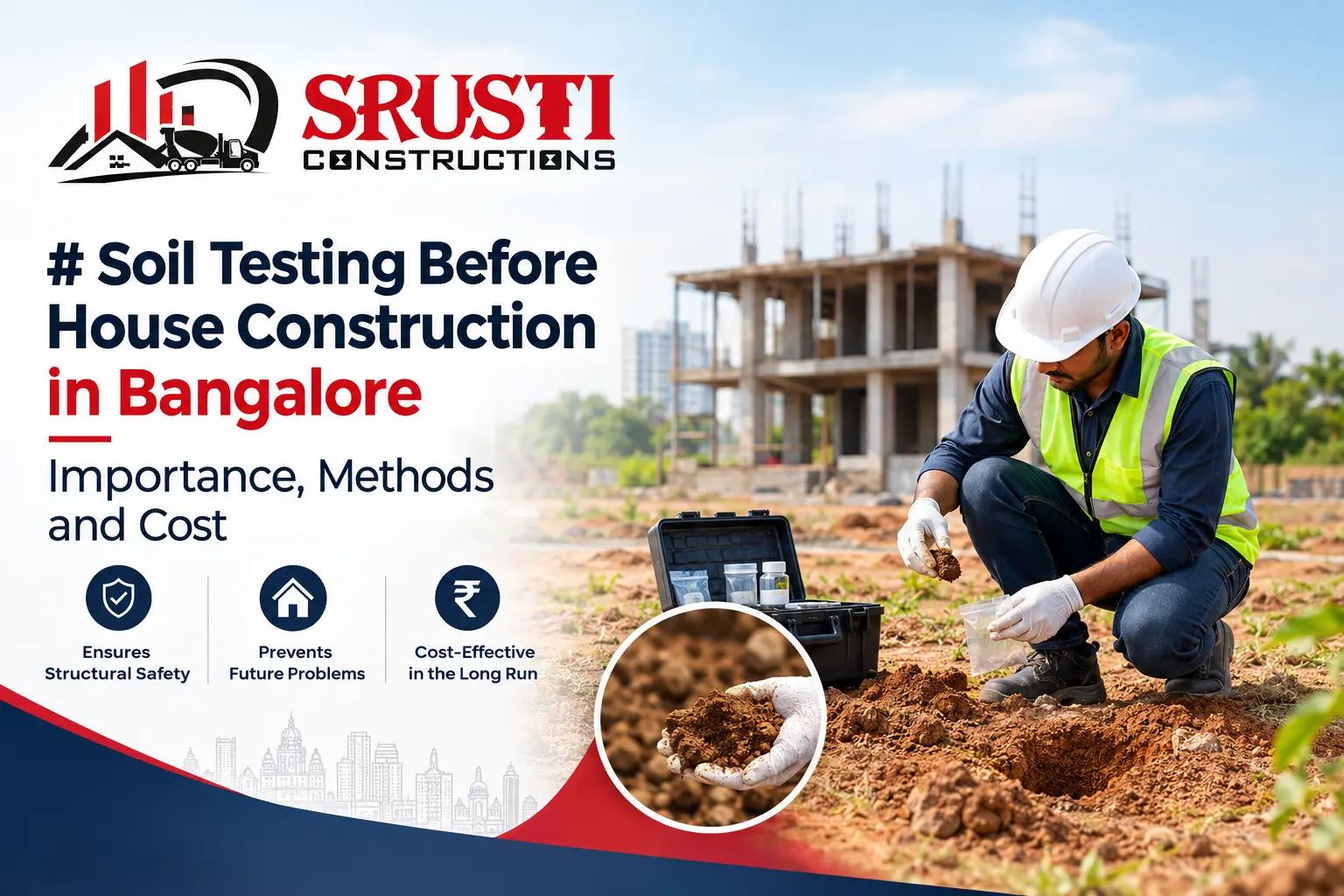
Soil Testing Before House Construction in Bangalore: Importance, Methods and Cost
Planning to build a house in Bangalore? Before finalising your house plans, it is important to understand the ground on which your home will stand. Soil Testing Before House Construction helps engineers evaluate soil strength, moisture conditions and other properties that influence foundation design.
Soil conditions can vary between neighbouring plots, even within the same locality. Therefore, testing your land before construction can help reduce the risk of foundation problems, unexpected expenses and structural damage.
What Is Soil Testing and Why Is It Important Before House Construction?
Soil testing, also known as geotechnical investigation, examines the ground to determine its suitability for supporting a building. It provides engineers with the information needed to plan an appropriate foundation.
Understanding Soil Properties and Load-Bearing Capacity
The soil bearing capacity for foundation refers to the ground's ability to support structural loads without bearing failure or excessive settlement. Engineers consider soil type, density, strength and moisture when designing foundations.
How Soil Testing Helps Prevent Foundation Problems
The importance of soil testing becomes clear when considering problems such as uneven settlement, wall cracks and foundation movement. Proper Soil Testing Before House Construction helps engineers identify weak soil layers and assess groundwater conditions before foundation work begins.
How Is Soil Testing Done Before House Construction?
The investigation generally involves site inspection, field testing, laboratory analysis and preparation of a soil report. These stages help engineers understand the ground conditions before construction planning is completed.
Site Inspection and Soil Sample Collection
A geotechnical team examines the plot, drainage, surface conditions and proposed building requirements. Boreholes may then be drilled to collect soil samples and investigate underground layers at suitable depths.
Laboratory Testing and Soil Analysis
Samples undergo relevant tests to determine properties such as moisture content, particle-size distribution, plasticity and strength. The tests selected depend on the site conditions.
Understanding the Soil Investigation Report
The report typically includes borehole logs, test results, groundwater observations and recommendations relevant to foundation design. A qualified geotechnical or structural engineer should interpret these findings before the foundation is finalised.
Types of Soil Tests Used for Residential Construction
Different soil testing methods help engineers understand specific ground conditions. The investigation plan should be tailored to the property rather than relying on the same tests for every house.
Standard Penetration Test (SPT)
SPT is a common field test performed in boreholes. Its results help assess soil resistance and inform foundation design.
Soil Moisture Content and Atterberg Limits Tests
Moisture content testing measures the water present in soil. Atterberg limits help evaluate the plasticity of fine-grained soils, which is particularly useful when assessing clay.
Soil Compaction and Sieve Analysis
Sieve analysis determines the distribution of soil particle sizes. Compaction testing evaluates how soil responds to compaction and can be useful when planning filling or levelling work.
Plate Load Test and Chemical Testing
A plate load test evaluates ground response under an applied load when appropriate. Chemical testing may identify substances that could affect concrete or reinforcement. CBR testing is mainly associated with pavement and subgrade evaluation, not as a universal foundation-bearing-capacity test. The appropriate investigation depends on the engineer's assessment.
Different Soil Types Found in Bangalore and Their Impact on Foundations
Understanding soil types in Bangalore helps homeowners recognise why foundation requirements can differ from one property to another.
Red Soil and Lateritic Soil
Red soil occurs across parts of Bangalore. Its suitability depends on factors such as density, depth and the presence of weaker layers. Lateritic ground also requires site-specific evaluation.
Clayey Soil and Expansive Soil
Some clayey soils swell when wet and shrink as they dry. These volume changes can contribute to foundation movement if not considered during design.
Rocky Soil and Weathered Rock
Rock near the surface may provide suitable support, but weathering, fractures and variations in rock depth can affect excavation and foundation planning.
Mixed Soil Conditions and Groundwater
A plot may contain several soil layers, filled ground or groundwater at varying depths. These conditions can influence excavation, drainage and foundation selection.
How Soil Testing Helps Determine the Right Foundation
Soil investigation helps engineers choose a foundation that suits both the ground conditions and the proposed building. The findings from Soil Testing Before House Construction support decisions about foundation depth, design and settlement control.
Shallow Foundations and Strip Footings
Where near-surface soil is suitable, engineers may consider isolated footings, combined footings or strip foundations, depending on the structural design.
Raft Foundations and Pile Foundations
Raft foundations distribute loads across a larger area. Pile foundations may be considered when suitable supporting strata lie deeper underground or when shallow foundations are unsuitable.
Preventing Uneven Settlement and Structural Cracks
Identifying weak layers and differences in soil conditions helps engineers assess settlement risks and design an appropriate foundation. This can reduce the likelihood of costly repairs later.
Soil Testing Cost in Bangalore: What Homeowners Should Know
The soil testing cost in Bangalore depends on the investigation scope, so homeowners should obtain quotations for their specific plot rather than rely on an unverified standard price.
Factors That Affect Soil Testing Cost
Costs may depend on the number of boreholes, investigation depth, drilling conditions, laboratory tests, equipment access and report requirements.
Number of Boreholes, Testing Depth and Plot Conditions
The number and depth of boreholes are determined by the building requirements and ground conditions. Difficult site access or hard rock may also affect the work involved.
How to Compare Soil Testing Quotes
Ask providers to specify the boreholes, testing depths, field and laboratory tests, report deliverables and estimated completion time. Comparing quotations with the same scope makes it easier to assess value.
When Should You Conduct Soil Testing Before Building a House?
The Best Time to Test Your Plot
Arrange soil testing before finalising structural drawings and foundation design. Early investigation gives your engineer time to incorporate the findings into the construction plan.
How Long Does Soil Testing Take?
The duration depends on fieldwork, laboratory testing and report preparation. Request a timeline from the selected provider based on the investigation required.
How to Choose a Soil Testing Laboratory in Bangalore
Checking Laboratory Credentials and Relevant Accreditation
When choosing a soil testing lab in Bangalore, look for experienced geotechnical professionals, appropriate equipment and relevant accreditation for the tests required. Check that the laboratory's accredited scope covers the specific tests being offered.
Reviewing the Soil Report with a Geotechnical Engineer
Ask a qualified engineer to explain the findings, recommended founding depth, groundwater observations and foundation considerations. A clear report should support practical engineering decisions.
Common Soil Testing Mistakes Homeowners Should Avoid
Assuming Nearby Plots Have Identical Soil
Neighbouring properties may have different soil layers, fill material and groundwater conditions. Your plot should be investigated according to its own requirements.
Selecting a Foundation Without Soil Investigation
Choosing a foundation based only on nearby buildings or assumptions may lead to unsuitable design decisions and unnecessary costs.
Ignoring Groundwater and Soil Variability
Groundwater and soil layers can vary across a property and over time. These factors should be considered wherever relevant to foundation design and excavation.
Frequently Asked Questions About Soil Testing
Is Soil Testing Necessary for an Individual House?
Soil investigation is strongly recommended because it provides important information for designing a suitable foundation, even for a small independent house.
How Deep Should Soil Be Tested for a Residential Building?
There is no universal depth. The geotechnical engineer determines the investigation depth based on building loads, soil conditions and the proposed foundation.
How Much Does Soil Testing Cost in Bangalore?
The price depends on borehole numbers, depth, testing requirements and site conditions. Request itemised quotations from qualified providers.
Can Soil Testing Identify Groundwater Conditions?
Yes. Investigations can record groundwater encountered during fieldwork. However, levels may change seasonally, so the recorded measurement may not represent the highest groundwater level.
Who Interprets the Soil Testing Report?
A qualified geotechnical engineer prepares or interprets the investigation findings, while the structural engineer uses the relevant recommendations in foundation design.
Does Every House Plot Need the Same Soil Tests?
No. Testing requirements vary according to the site's geology, building design and investigation findings.
Build a Strong Foundation with Proper Soil Testing
Soil Testing Before House Construction is an important step towards building a safe and durable home. It helps engineers understand ground conditions, assess foundation options and identify potential problems before construction begins.
Why Choose Srusti Constructions?
Srusti Constructions believes that well-planned construction begins with informed decisions and attention to structural requirements. Coordinating foundation planning with qualified technical professionals helps ensure that site conditions are considered before work proceeds.
Ready to Build Your Home in Bangalore?
Planning your dream home? Choose Srusti Constructions for professional guidance on house construction in Bangalore. Get in touch with us to discuss your plot, soil testing requirements, foundation planning, construction needs, and budget. Visit our Srusti Constructions website or Srusti Constructions YouTube Channel to learn more about our work. Plan carefully. Verify thoroughly. Build confidently.
